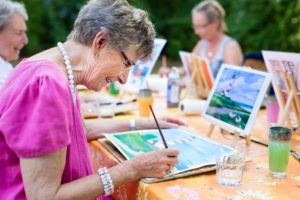
The Creative Workshop is a powerful and flexible tool that offers remarkable benefits even in older age. As we grow older, issues related to health, memory, and social interaction may arise. Art can provide a channel for facing these changes, keeping creativity and personal expression alive.
At this stage of life, verbal language may become limited, either due to physical difficulties or cognitive decline. The Creative Workshop bypasses the need to find words to communicate, allowing expression through a non-verbal, familiar, and intuitive medium.
Artistic language stimulates cognition and improves emotional well-being. During creative activities, older adults are engaged in mixing colours, moulding clay, creating collages, or drawing. These actions require coordination and attention, stimulating different areas of the brain.
Creative activity can also act as a powerful sensory trigger to evoke past memories. Producing an image or working with photographs linked to an event or place may help individuals relive—and sometimes reprocess—important fragments of their lives, supporting access to memory.
Taking part in the Creative Workshop can help reduce anxiety and depression, as it encourages focus on the present moment and the activity at hand, reducing attention to negative thoughts or health worries. It provides a sense of calm and fulfilment.
Creating an artwork restores a sense of competence and self-esteem, often challenged by the loss of independence. Older adults regain the feeling of being able to produce something meaningful. These aspects are essential for improving emotional well-being.
Pathological Ageing (Dementia and Alzheimer’s)
The Creative Workshop is especially valuable in pathological ageing, particularly in the early and middle stages of dementia and Alzheimer’s. Although short-term memory declines, procedural skills (such as painting or drawing) and emotional memory often remain intact for longer. Art helps maintain residual abilities, allowing individuals to exercise and preserve them.
Producing a work of art becomes a means of communication even when speech is no longer accessible. The practitioner can use the created image to connect empathetically with the person, establishing effective communication that reduces isolation and frustration.
Sessions may be conducted individually or in small groups, but for older adults group sessions are recommended, as they provide a crucial opportunity to counteract social isolation—one of the greatest challenges of later life. Creating in a group, without needing to speak or remember, promotes social interaction and a sense of belonging.
The Creative Workshop offers a beautiful opportunity to celebrate an elderly person’s life journey, keeping expression and reminiscence active, and above all continuing to bring colour to the present.