Advice for school
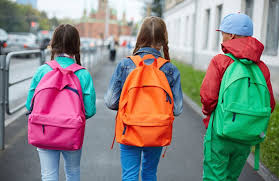
A topic that has been very relevant for several years now concerns the relationship between school backpacks (which are often quite heavy because of the number of books children must carry) and their possible consequences on children’s backs and posture.
More and more frequently, we see the traditional backpack being replaced with a trolley bag, in order to avoid placing excessive weight on children’s spines and to prevent them from adopting incorrect postures. But are we really sure that this is the best solution? In this article, together with the most recent scientific literature, we aim to provide some practical advice for parents on how to manage this situation.
Studies show that heavy backpacks (that is, backpacks weighing more than 10% of the student’s body weight) lead to significant changes in several aspects of the body. These include changes in the back (greater flexion in the lumbosacral region and increased thoracic kyphosis), in the biomechanics of walking (increased plantar pressure during gait and longer foot contact time with the ground), and in respiratory mechanics (an increased breathing rate, with a preference for thoracic breathing).
In simple terms, walking with excessive weight on the back causes children to walk with their backs more bent forward, taking shorter and slower steps, resulting in a more tiring gait and a posture similar to that adopted during intense physical effort.
However, we would like to reassure our readers: no study has found a correlation between heavy backpack use and back pain or the development of scoliosis. The changes described above are natural adaptations in response to carrying an external load.
The opinion of several authors
Many authors highlight the following points:
1) The main issue appears to be the duration of exposure to the load and the capacity of the tissues to tolerate stress, rather than the weight itself. Carrying very heavy backpacks for five days a week, with journeys between home and school lasting more than 30 minutes, may lead to the development of mild to moderate back pain, particularly in sedentary children.
2) Getting children used to carrying loads that progressively increase with age and school years may be comparable to progressive training over time, allowing the body’s structures to adapt gradually to higher loads.
3) Finally, many studies show that there are numerous positive effects of introducing strength training with external loads in children (from around 7 years of age). These include improvements in posture, coordination, and strength, as well as supporting bone health. Importantly, this does not hinder musculoskeletal growth. Naturally, this does not mean asking children to lift maximal weights. As in all sports, the process begins with correct technique and bodyweight exercises, gradually progressing towards more challenging activities over time.
Sedentary lifestyle and movement
Children who are more sedentary appear to have a higher likelihood of developing back pain, whereas those who regularly practise sport tend to develop a body structure that is better able to tolerate external stresses, such as carrying school backpacks.
For this reason, our recommendation is not to focus solely on the weight of the backpack, but rather to consider the overall lifestyle of the child throughout the day and week. Does the child engage in moderate to vigorous physical activity during the week, or do they lead a mostly sedentary lifestyle, despite their young age?
Without focusing exclusively on weightlifting as a sport at a young age (which children may or may not enjoy), research does not identify one physical activity as clearly superior to another. Instead, studies emphasise that a physically active child develops a body that is more adaptable to the demands of everyday life. The best activity is simply the one that the child enjoys and looks forward to doing.
As always, in the case of persistent pain or if you have any concerns, our advice is to contact your paediatrician.
For further information or clarification, please do not hesitate to contact us at Polispecialistico Paradiso.