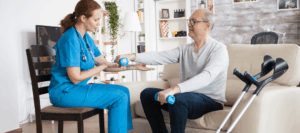
Home Rehabilitation
It is often believed that effective rehabilitation requires complex equipment or fully equipped gyms. In reality, the home environment is rich in valuable resources: a chair, a step, or even a simple wall can become essential therapeutic supports. Under the professional guidance of a physiotherapist, it is possible to carry out targeted therapeutic exercise programmes, ensuring both safety and technical precision.
Five fundamental activities organised by muscle groups
1) Arm strengthening with stable support
Using the armrests of a chair, the edge of a stable piece of furniture, a table, or a sofa, pushing exercises can be performed to strengthen the upper limb muscles. Under the supervision of the physiotherapist, the focus is placed on movement control to avoid compensations involving the neck or shoulders. This exercise is essential for improving everyday activities that require pushing, lifting, or supporting the body with the arms.
2) Posterior chain strengthening in quadruped position
Using the bed surface or a mat, alternating lifts of opposite arm and leg are performed while maintaining a four-point (quadruped) position. This activity aims to strengthen the spinal extensor muscles, the gluteal muscles, and the scapular stabilisers simultaneously. The physiotherapist ensures that the spine remains neutral, preventing pelvic rotation or excessive lumbar arching, thereby improving overall trunk stability.
3) Core activation and abdominal stability
Using a bed surface or an exercise mat, exercises are performed to activate the deep abdominal muscles. The activity focuses on maintaining pelvic stability while performing small controlled movements of the arms or legs. The physiotherapist guides the correct coordination between breathing and muscle activation, helping to create a natural “core corset” that supports the body when lifting heavier loads during everyday activities.
4) Squat or “Sit-to-Stand” for quadriceps strengthening
This exercise involves standing up from and sitting down on a chair correctly, with the aim of strengthening the thigh muscles, particularly the quadriceps. The physiotherapist’s guidance is essential to correct weight distribution and knee alignment. Using one’s own chair allows this functional movement to be trained specifically, which is fundamental for maintaining independence in mobility and preventing weakness in the lower limbs.
5) Calf strengthening on a step
Using the first step of an indoor staircase, it is possible to work on the strength of the lower leg muscles. This activity turns a common architectural feature into an effective training station for improving push-off strength and stability during walking.
The true value of professional home supervision lies precisely in these details. Although watching online exercise videos may be immediate and convenient, the correct execution of therapeutic exercises requires a proper clinical assessment. The presence of a physiotherapist at home is essential to adapt the training load to current health conditions, correct mistakes in real time, and structure a rehabilitation programme that integrates seamlessly into the daily home routine, while minimising the risk of injury or inefficient compensatory movements.
If you would like to learn more, do not hesitate to contact us at Polispecialistico Paradiso.