What is De Quervain’s Syndrome?
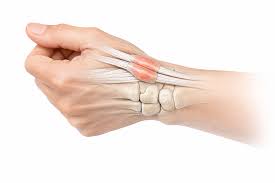
De Quervain’s syndrome is a condition affecting the first extensor compartment of the hand, where two thumb tendons run: the abductor pollicis longus and the extensor pollicis brevis.
It is defined as a stenosing tenosynovitis, characterised by an inflammatory process affecting the synovial sheath, resulting in narrowing of the tendon sheath. This narrowing creates friction during tendon movement, leading to pain.
What are the symptoms?
Symptoms include pain localised on the outer side of the wrist, just below the thumb. Pain may occur when pressure is applied to the area or during specific thumb movements, particularly flexion and extension, and during activities involving overload. People affected by this condition often report stiffness and weakness in the thumb and wrist.
When the condition develops as a consequence of hormonal changes, pain is generally more severe than in cases caused by mechanical overuse.
Causes
The most common causes include:
- Excessive or sudden overuse
- Repetitive thumb flexion and extension activities
- Rheumatic diseases
- Genetic predisposition
- Age and sex: women between 30 and 50 years of age are more likely to develop the condition
- Pregnancy and the post-partum period, when hormonal changes play a major role
Daily activities that may contribute to the condition include computer mouse use, typing on a mobile phone, lifting and gripping heavy objects. It may also occur in people who practise sports such as tennis, golf and climbing, where the thumb is placed under constant strain.
Treatment
Treatment may be conservative or post-operative.
Conservative treatment includes the use of a custom-made splint to reduce stress on the affected structures. Anti-inflammatory treatments may be provided through physical therapies such as ultrasound therapy and TECAR therapy. Joint mobilisation and stretching exercises for the tendons of the first extensor compartment are also commonly prescribed.
During the post-acute phase, rehabilitation progresses to wrist mobilisation with gradually increasing resistance, muscle strengthening exercises and functional re-education to support a return to work and leisure activities.
Surgical treatment involves making an incision in the synovial sheath to release the tendons and allow them to glide freely. This eliminates friction and the associated pain.
Post-operative rehabilitation includes wound care and dressing management, suture removal, mobilisation of the wrist and fingers, and scar management. If inflammation persists, physical therapies such as ultrasound therapy and TECAR therapy may be used. In the final stages, progressive muscle strengthening and functional re-education are introduced to facilitate a safe return to work and leisure activities.
If you want to know more about De Quervain’s Syndrome do not hesitate to contact us here at Polipecialistico Paradiso!